Crypto Project Valuation Methods: An Expert Guide
With the crypto market reaching a valuation of $2.3 trillion in 2021 and projections indicating significant growth beyond 2025, it’s crucial for investors to understand crypto project valuation methods. As the landscape evolves, knowing how to assess the worth of a digital asset or blockchain project becomes vital for making informed investment decisions.
The Importance of Valuation in Crypto Investments
In an industry where $4.1B was lost to DeFi hacks in 2024, understanding how to appropriately value a crypto project is not just helpful, but essential. Valuation methods provide a framework through which investors can gauge the legitimacy and potential success of a project, especially in a rapidly changing market.
- Identifying potential investment risks
- Determining realistic price targets
- Assessing long-term viability
This guide breaks down the prevalent valuation methodologies while considering the specifics of the Vietnamese market. Increasing user growth—up to 32% year-on-year—makes Vietnam an exciting area for crypto investment.
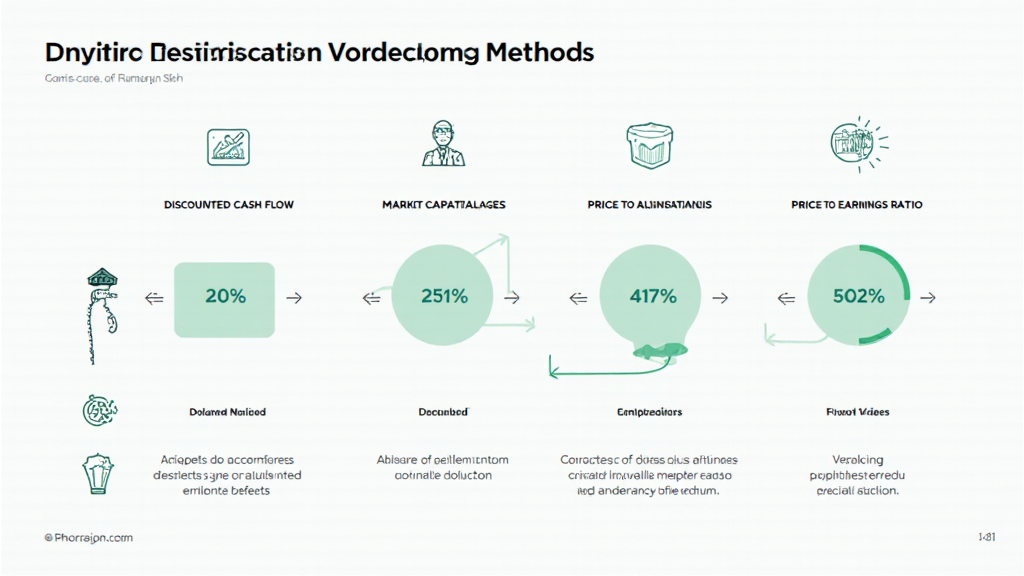
Key Valuation Methods
There are several commonly used methods to value cryptocurrency projects, which will be discussed in detail below:
1. Discounted Cash Flow (DCF)
Similar to traditional finance, the DCF model assesses the present value of a project’s expected future cash flows. Investors must estimate cash flows based on realistic financial projections. One way to approach this is by:
- Forecasting revenue from transaction fees or app usage.
- Discounting these revenues back to their present value using an appropriate discount rate.
Just like a bank vault protecting cash, a thorough understanding of projected cash flows guards against unrealistic expectations.
2. Market Capitalization
Market cap is calculated by multiplying the current price of a cryptocurrency by the circulating supply. Simple yet effective, this method gives an immediate view of a project’s standing in the market. However, it’s essential to consider:
- Market manipulation leading to inflated price
- Token supply changes over time
3. Price to Earnings (P/E) Ratio
The P/E ratio compares a project’s market cap to its earnings. While not universally applicable to all crypto assets (especially those with no earnings), it can provide insight into established platforms that generate revenue. It’s analogous to evaluating businesses in traditional sectors.
Comparative Metrics in Crypto Valuation
Beyond individual valuation methods, benchmarking against similar projects is crucial for investors. This includes assessing:
- Market positioning relative to direct competitors.
- Technological advancements.
- Community support and developer engagement.
A table illustrated below demonstrates comparative metrics between several notable cryptocurrencies:
| Project | Market Cap ($) | Annual Revenue ($) | P/E Ratio |
|---|---|---|---|
| Bitcoin | 830B | 0 | N/A |
| Ethereum | 450B | 4B | 113 |
| Cardano | 60B | 0.5B | 120 |
Source: CoinMarketCap 2025
Evaluating New and Emerging Projects
When it comes to new and emerging projects, particularly in the growing Vietnamese market, understanding that traditional valuation metrics may not apply can help investors remain grounded. Instead, consider:
- The team’s expertise and track record
- Use-case potential and technological differentiation
- Community engagement and marketing strategies
For instance, let’s take a look at a promising Vietnamese project, XYZ Token, which offers unique solutions for the local fintech market.
Future Outlook: 2025 and Beyond
As we look to 2025, the potential for disruptive technologies in cryptocurrency continues to grow. With strong foundations laid in past years, many believe that valuation methods will adapt, integrating more advanced machine learning algorithms and AI models to predict price movements.
Particularly in Vietnam, where crypto adoption rates are surging, investors should prepare to leverage these tools to navigate challenges better.
Concluding Thoughts on Crypto Valuation
In conclusion, understanding crypto project valuation methods is indispensable for investors. As new projects emerge in a rapidly evolving market, so do strategies for valuation. Keep an eye on upcoming trends for effective decision-making.
Note: This content does not represent financial advice. It is advisable to consult local regulators for compliance and further guidelines.
By leveraging the investment methods detailed above, the risks associated with crypto investments can be mitigated significantly. This guide has hopefully illuminated valuable insights into how to explore potential investments in the burgeoning Vietnamese market.
Stay informed, stay safe, and let the numbers guide your investments!
Written by Dr. Alex Tran, PhD in Blockchain Technology, author of over 15 papers on cryptocurrency investment methodologies and principal auditor for several top-tier blockchain projects.